





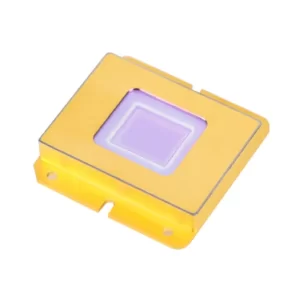
InGaAs Focal Plane Arrays: Definition and Key Principles
InGaAs (Indium Gallium Arsenide) focal plane arrays (FPAs) are two‐dimensional infrared detector chips sensitive to the short-wavelength infrared (SWIR) band (~0.9–1.7 µm). Each pixel is a PIN photodiode on an InGaAs substrate hybridized (via indium bumps) to a CMOS readout chip. When SWIR photons hit the InGaAs diode, they generate electron–hole pairs; the readout integrated circuit then measures the resulting charge as a voltage to form an image. Compared to silicon detectors, InGaAs has a smaller bandgap, giving high quantum efficiency (QE) deep into the NIR/SWIR range with low reverse bias. As a result, InGaAs FPAs can achieve excellent sensitivity in 0.9–1.7 µm (and in specialized designs even down to ~0.4 µm or up to ~2.5 µm). The hybrid InGaAs/CMOS design also allows very fast readout; by providing multiple analog outputs, modern InGaAs FPAs can support high frame rates (hundreds of Hz) and very short exposure times.
Key performance parameters include:
- Format & Pixel Pitch: Common formats are 320×256, 640×512, etc. Larger arrays (e.g. 1024×1024) are emerging but more complex. Pixel pitch typically ranges from ~12.5 µm up to 30 µm. Larger pixels collect more photons (improving low-light SNR) but give lower spatial resolution for a fixed array size. The GD‑NIR32030M uses a 320×256 array with 30 µm pixels. By contrast, very compact SWaP-optimized cameras (e.g. Sensors Unlimited Micro-SWIR) use 320×256 at 12.5 µm pitch to save size and power, accepting reduced per-pixel sensitivity.
- Spectral Range: Typical InGaAs is sensitive ~0.9–1.7 µm (set by the InGaAs bandgap). Many designs extend to visible blue by removing an IR-pass filter (reaching ~0.4 µm) or extend beyond 1.7 µm by lattice engineering. The GD‑NIR32030M offers both the standard 0.9–1.7 µm band and an optional 0.4–1.7 µm visible-enhanced version.
- Quantum Efficiency (QE): QE is the fraction of incident photons converted to charge. InGaAs FPAs typically achieve 60–80% QE over 1.0–1.6 µm. For example, Lontenoe specifies ≥75% QE (1.0–1.6 µm) for the GD‑NIR32030M. Sensors Unlimited’s 320CSX camera is >65% in the same band.
- Dark Current and Noise: Dark current (thermally generated charge) is the dominant noise source. Uncooled pixels often have dark currents in the 10^4–10^6 electrons/sec range per pixel. Cooling via thermoelectric (TEC) stages dramatically reduces dark current and noise. For example, the GD‑NIR32030M’s dark current is ≤8×10^5 e–/s per pixel at –0.2 V bias. By comparison, a 2-stage cooled Hamamatsu InGaAs FPA reports only ~0.3 pA (~2×10^3 e–/s) per pixel at 25°C, illustrating the benefit of cooling. Read noise (amplifier noise) in modern InGaAs FPAs is typically on the order of tens of electrons RMS; Lontenoe lists ≤1.5 mV output noise (high gain) for the GD‑NIR32030M.
- Full Well and Dynamic Range: The charge capacity of a pixel (full well) and the electronic dynamic range determine how well both dark and bright features can be captured. InGaAs FPAs often have full wells from ~10^5 to >10^6 electrons. The GD‑NIR32030M has full well ~3.5×10^6 e– (low-gain mode) and ~1.7×10^5 e– (high-gain), yielding ≥62 dB dynamic range.
- Frame Rate & Readout: InGaAs FPAs usually use a global-shutter (snapshot) readout. By using multiple readout channels and fast ADCs, frame rates of 100–300 Hz are common. For instance, GD‑NIR32030M can clock pixels at 10 MHz and achieve up to 300 fps in full-frame mode (4-channel readout). In contrast, single-channel SWaP cameras (12.5 µm pitch) are often limited to 30 fps.
- Cooling & Packaging: Many InGaAs FPAs are offered in thermoelectrically cooled packages to lower dark current. The GD‑NIR32030M comes in two options: a hermetic DIP metal shell with an integrated TEC (for cooled operation) and a compact CLCC ceramic package (uncooled). Cooling is optional but advisable for sensitive or long-exposure applications.
- Interfaces: These FPAs typically output digital video via CameraLink, USB3, or custom boards. All-Gbit Ethernet and USB interfaces are common. The GD‑NIR32030M can be paired with various readout electronics; Lontenoe’s cameras offer CMOS outputs (TTL/ADC) or higher-level interfaces.
Typical Applications of InGaAs FPAs
Because they see beyond visible light, InGaAs cameras excel in applications where silicon imagers fail. Typical use cases include:
- Imaging through Obscurants: SWIR light penetrates fog, haze, smoke, and dust better than visible light. In surveillance or autonomous vehicles, InGaAs cameras can “see” in fog or dim conditions that blind visible cameras.
- Laser Detection & Beam Profiling: InGaAs is sensitive to common laser wavelengths (e.g., 1.55 µm). High-speed global-shutter InGaAs cameras are used to profile or track lasers in industrial and defense systems.
- Industrial Inspection & Sorting: Many materials (plastics, seeds, wafers) have distinct SWIR signatures. For example, hidden defects in agricultural products (e.g. internal bruising) become visible in SWIR. SWIR cameras are widely used for semiconductor wafer inspection, solar cell analysis, and quality control (detecting moisture, fiber, or defects).
- Spectroscopy and Process Monitoring: InGaAs arrays serve as detectors in spectrometers (pump SWIR OSA, NIR spectroscopy) and in inline process monitoring for chemical analysis.
- Medical & Life Sciences: SWIR imaging is emerging in microscopy and preclinical imaging (e.g, using NIR-II fluorescent probes). The reduced scattering at >1 µm enables deeper tissue imaging.
- Scientific Research (Astronomy & Labs): Infrared astronomy and adaptive optics employ cooled InGaAs arrays. Their low noise and high speed make them useful for night-sky imaging and laser guide-star systems.
- Active Imaging: Combined with NIR illumination (e.g., 1.5 µm laser), InGaAs cameras enable covert night vision (illumination invisible to humans) and optical wireless communication links.
InGaAs Focal Plane Arrays – Lontenoe GD‑NIR32030M: Performance and Features
The GD-NIR32030M is a high-performance InGaAs array sensor from Lontenoe. It is built as a hybrid device (InGaAs photodiode array + CMOS ROIC) and is offered in both cooled and uncooled versions. Its key specifications include:
- Array:320 × 256 pixels, 30 µm pitch. This yields a 9.6 mm × 7.68 mm active area.
- Spectral Range: Standard SWIR (0.9–1.7 µm); optional visible-enhanced band (0.4–1.7 µm).
- Quantum Efficiency:≥75% in the main band (1.0–1.6 µm), with pixel fill factor ≥99%.
- Dark Current:≤8×10^5 electrons/sec per pixel (at –0.2 V bias). (For reference, at room temperature, an uncooled InGaAs pixel might have dark current in this range; with TEC cooling it drops much lower.)
- Noise & Dynamic Range: Output noise ≤1.5 mV RMS (high-gain mode); dynamic range ≥62 dB.
- Full Well Capacity:~1.7×10^5 e– (high gain) and ~3.5×10^6 e– (low gain).
- Readout: Supports 1, 2, or 4 analog outputs (multi-tap). Pixel clock up to 10 MHz. In 4-output mode, it can achieve up to 300 full-frame images per second. Shortest integration time is 1 µs (ultra-short mode).
- Integration/Gain: User-adjustable integration time and gain. Onboard 2-point (offset + gain) non-uniformity correction is available.
- Interface & Packaging: Supplied in a hermetic DIP metal shell (MD version) with built-in dual-stage TEC and vacuum seal, or in a compact CLCC ceramic package (CL version) without TEC. The DIP-TEC version is 3.0 g, and the CLCC is 3.5 g. Both allow standard C-mount optics.
- Temperature Monitoring: The sensor chip includes a temperature sensor for real-time monitoring.
- Reliability: Designed for both cooled and ambient use with high operability (≥99.5% of pixels) and uniformity.
- Applications: Lontenoe targets this FPA at SWaP-sensitive and fast-imaging applications: low-light SWIR imaging, laser tracking/identification, smoke/fog penetration, semiconductor inspection, agricultural sorting, and more.
Overall, the GD‑NIR32030M combines very large 30 µm pixels (for high sensitivity) with a very fast multi-channel readout (for high frame rate). Its high QE, low noise, and flexible packaging make it competitive in demanding SWIR applications.
Mainstream InGaAs FPA Comparison
The table below compares the GD‑NIR32030M against similar 320×256 SWIR FPAs from other vendors (e.g. Xenics, Sensors Unlimited, Hamamatsu). It highlights key procurement parameters:
Model (Vendor) | Format | Pixel Pitch (µm) | Spectral Range (µm) | QE (%) | Dark Current | Frame Rate | Cooling | Packaging |
GD‑NIR32030M (Lontenoe) | 320×256 | 30 | ≥75 (1.0–1.6 µm) | ≤8×10^5 e–/s per pixel (at –0.2 V) | 100 fps (1-output); 200 fps (2-output); 300 fps (4-output) | Yes (integrated TEC) / No (CLCC) | DIP metal (TEC) / CLCC ceramic | |
Xeva 1.7 320 (Xenics) | 320×256 | 30 | 0.9–1.7 (SWIR) (vSWIR option to 0.5 µm) | ~70 (typical) | – (not specified) | Up to 344 Hz (full frame) | Yes (TE-cooled, TE1/TE3) | Camera (C-mount) with CameraLink/USB |
320CSX (Sensors Unlimited) | 320×256 | 12.5 | >65 (1.0–1.6 µm) | – (uncooled; stabilized) | 30 fps (full frame) | No (ambient operation) | OEM PCB / small enclosure | |
G14672-0808W (Hamamatsu) | 320×256 | 20 | – (InGaAs typical ~60–80%) | ~0.3 pA @ 25°C (–20°C chip) | 509 fps (max) | Yes (2-stage TEC) | Metal CAN (hermetic) |
Sources: Lontenoe GD‑NIR32030M datasheet; Xenics Xeva-320 brochure; Sensors Unlimited 320CSX datasheet; Hamamatsu G14672-0808W product page. (Lasermate’s 320×256 FPA30C32917 is a comparable 30 µm InGaAs array (0.6–1.7 µm, >70% QE, ~346 fps) often used in SWIR cameras.)
InGaAs Focal Plane Arrays Technical Differentiation & Trade-Offs
Pixel Pitch (Resolution vs. Sensitivity)
Larger pixels collect more light (higher photon count) but at the cost of spatial resolution. A 30 µm InGaAs pixel has ~6× the area of a 12.5 µm pixel, allowing roughly √6 ≈ 2.5× better SNR for the same illumination (ignoring other noise). Thus, the 30 µm GD‑NIR32030M is far more sensitive per pixel than a 12.5 µm SWaP camera, enabling low-light imaging, but it yields fewer pixels across a scene. Small-pixel (12.5–15 µm) FPAs (like the SU 320CSX or Xenics 640 with 15 µm) produce higher imaging resolution and larger FOV, at the expense of requiring more light or gain. System designers choose pixel size based on whether sensitivity (low-light/starved scenes) or resolution (fine detail) is paramount.
Signal-to-Noise Ratio (SNR)
SNR is driven by QE and total noise (shot + dark + read noise). High QE and large pixels boost signal (photon shot noise ∝√signal), improving SNR. Noise sources in InGaAs include dark current noise (dominant in long exposures) and readout noise. Larger pixels often have higher dark current (proportional to area), but their much larger signal offsets this. In practice, a cooled 30 µm FPA can outperform an uncooled small‐pixel FPA in SNR for the same scene. For example, Hamamatsu’s cooled 20 µm sensor produces only ~0.3 pA dark at 25°C, whereas an uncooled 12.5 µm pixel might have tens of nA. The GD‑NIR32030M’s 800,000 e–/s dark per pixel is moderate and can be further reduced by its built-in TEC, so it achieves excellent SNR in darkness.
Dark Current & Cooling
Uncooled InGaAs FPAs are useful for brief exposures or bright scenes but accumulate dark charge quickly during long exposures. Thermoelectric cooling is often used: each stage (TE1, TE2, etc.) roughly halves dark current for a ~15–20°C drop. GD‑NIR32030M’s TEC-cooled version keeps the array cool and stable, dramatically reducing dark noise. By contrast, the CLCC (uncooled) version is better for warm-room or daytime use. In general, cooled sensors suit night-vision, scientific imaging, or long integration (where SNR is critical), while uncooled/snapshot sensors suit high-speed daylight applications.
Frame Rate
High frame rate is critical for fast events (laser pulses, moving objects). Multi-output FPAs like GD‑NIR32030M (4 taps) or Xenics (multi-tap TE3) can reach hundreds of Hz. The trade-off is data rate and power: faster readout increases noise and heat. Slow-read FPAs (single output) have lower noise but top out at a few tens of Hz. Users balance speed vs. noise: GD‑NIR32030M can run at 300 Hz full-frame (4 taps) or 100 Hz with one tap, offering flexibility.
InGaAs Focal Plane Arrays Application Suitability
Each sensor’s design makes it best for certain domains.
– Low-Light/Night Imaging: Favor cooled large-pixel arrays (e.g. GD‑NIR32030M with TEC, Xenics TE3, Hamamatsu cooled) for highest sensitivity and SNR.
– Laser Tracking & LIDAR: Need global shutter, high frame and short integration. GD‑NIR32030M (min 1 µs exposure) and Xenics 320 (global shutter, up to 344 Hz) are ideal.
– Machine Vision/Inspection: If scene is well-lit, SWaP and frame rate may dominate. Compact cameras like SU 320CSX (small, 12.5 µm, 30 fps) or Lasermate’s uncooled modules can run 60+ Hz with low power. For detailed NIR inspection under controlled illumination, larger-pixel cooled cameras provide better image quality.
– Dual-Band/Visible+NIR: Sensors with extended visible response (e.g. GD‑NIR32030M’s 0.4–1.7 µm option) capture more spectral information, useful in graphics and biotech.
– High Temp or IR Thermography: InGaAs FPAs linear up to ~1.7 µm are excellent for measuring high-temperature objects through glass (e.g. FLIR A6260 mentions linearity from 0.6–1.7 µm).
Conclusion
In summary, Lontenoe’s GD-NIR32030M stands out by combining very high sensitivity (30 µm pixels with ≥75% QE) and high speed (up to 300 fps) in a single device. Its dual packaging (cooled TEC or uncooled CLCC) offers flexibility, and its wide dynamic range (62 dB) and low noise (≤1.5 mV) enable both low-light and high-contrast imaging. When compared to competitors, GD-NIR32030M offers a particularly attractive balance of large-pixel SNR and fast readout, making it well-suited for demanding SWIR applications such as low-light surveillance, laser detection, and real-time industrial imaging.